
What does a $200 monthly AI subscription actually buy?
Pricing pages tend to answer with “more usage” or “20x limits.” Those descriptions are hard to compare with an API bill. If you spend your working day asking agents to read repositories, change code, and run tests, you want to know how much work the monthly payment can support.
A test shared by @kunchenguid on X offers an unusually concrete starting point. The author used real subscriptions in a clean environment, ran repeated evaluation tasks in open-source repositories, and consumed five percentage points of each provider's quota. They recorded token usage across agent sessions and valued it at API list prices.
The reported monthly estimates are striking: about $12,000 for SuperGrok Heavy, roughly $7,000 each for the $200 ChatGPT Pro and Claude Max tiers, and $3,400 for Cursor Ultra.
Those numbers are enough to make you reconsider a renewal. Before changing subscriptions, though, it helps to understand exactly what has been counted.
The four subscriptions
These are the original author's figures. The monthly values extrapolate from the sample and assume that the full coding-agent allowance is used. Agent.Space has not independently repeated the experiment or obtained the per-call logs.
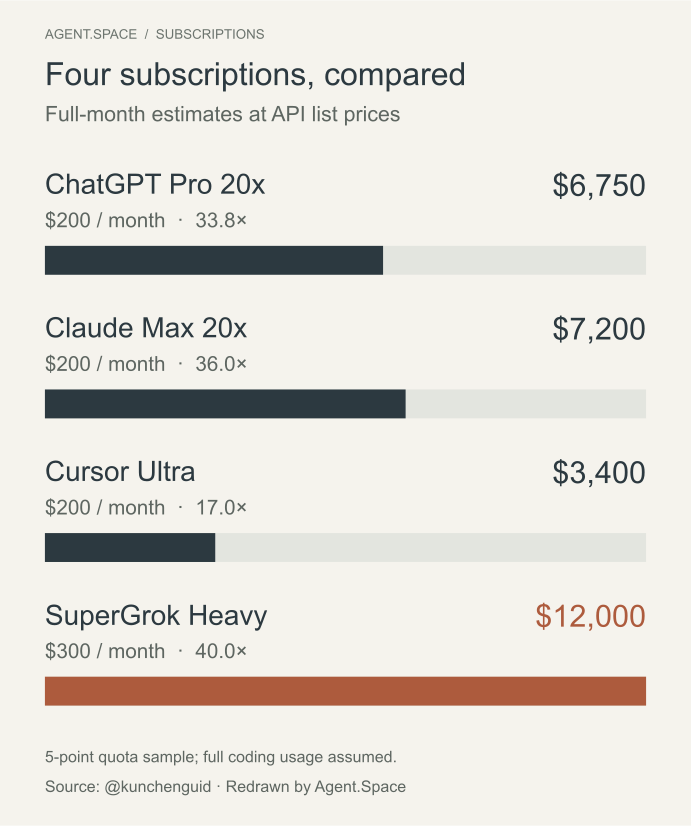
Source: @kunchenguid's original post. Chart redrawn by Agent.Space. These are reported estimates, not API credit balances promised by the providers.
On this measure, SuperGrok Heavy leads in both total value and value per dollar. Claude Max comes out about 6.7% above ChatGPT Pro, putting them in the same broad range. Without repeated measurements or an error estimate, that small difference is a poor basis for declaring a durable winner. Cursor Ultra comes in at roughly half the API-equivalent value of the other two $200 plans, a gap worth investigating in your own usage.
The “20x” in a plan name also has its own baseline. OpenAI compares its tier with ChatGPT Plus; Anthropic compares Max with Claude Pro. Neither label measures the ratio in the table's final column.
How much of that 40x value can you use?
The arithmetic is straightforward: the API list-price value of the estimated token usage, divided by the subscription price. Twelve thousand dollars divided by $300 gives 40.
The original post calls this ROI. For budgeting, “API-equivalent value multiple” is more precise: it describes the retail value assigned to the usage. Your savings depend on how much of that usage you would otherwise have paid for.
Consider a hypothetical month. You have work that would cost $300 through a suitable API setup. A $200 subscription completes it to the same acceptance standard with no extra charges. The cash saving you can compare is $100. If your actual needs amount to only $60 of API usage, a $200 subscription needs to justify the balance through its editor, chat, or other features. A large full-quota estimate does not create that saving for you.
The figures also cannot tell us how much a provider loses on each subscriber. API retail prices and the provider's own inference costs are separate accounting questions.
Model prices shape the ranking
API dollars are a convenient unit of comparison, but the unit still depends on the model's price.
Suppose two models finish the same code change to the same standard. If one model has a higher token price, an equal amount of usage produces a larger API-equivalent value. The comparison therefore reflects both the amount of usage available and the price assigned to it.
Caching adds another variable. Coding agents repeatedly carry repository files, tool descriptions, and earlier context into later requests. Fresh input, cache reads, cache writes, and output can have very different rates. Charging every input token at the fresh-input rate can produce a very different total from pricing the actual cache mix. The coding-agent API cost guide explains how to keep those categories separate.
The post and image do not include the full model versions, reasoning settings, cache breakdown, per-call logs, or the conversion from each quota's reset window to a monthly figure. The estimates can help identify plans worth testing, but those missing details prevent a complete reconstruction. A clean environment reduces interference; it does not make different models, harnesses, and quota systems identical.
Then there is the work itself. An agent can spend tokens rereading files and pursuing failed fixes. Those tokens still contribute to the reported value. The completed-work list records only the change that eventually passes review. Usage volume and time spent repairing output deserve separate entries in a comparison.
Unused capacity changes the result
The 40x figure assumes the corresponding coding allowance is fully consumed.
Using the author's estimate, and holding the task, model, and cache mix constant, consuming one quarter of the SuperGrok Heavy allowance gives $3,000 of API-equivalent usage, or 10x the subscription price. At one quarter utilization, Claude Max gives $1,800, or 9x. These are arithmetic illustrations of utilization, not forecasts of how many tasks an account can run.
Your schedule matters too. Light usage for most of the month followed by two frantic delivery days can leave ample theoretical capacity while still hitting a shorter usage window. Anthropic's Max documentation, for example, describes both five-hour session limits and a weekly allowance. Monthly billing does not mean all the capacity is available on a single day.
The author also excludes ordinary chat, Grok Bot, and other value outside coding-agent usage. People who use those features should add their own benefit back into the decision. Someone buying almost entirely for coding can keep a narrower comparison. Both can reasonably reach different conclusions from the same table.
Is Cursor Ultra still worth buying?
The original author concludes that Cursor Ultra no longer makes much sense for individual consumers. For someone who spends most of the allowance on third-party coding models and regularly runs out, that raises a fair question: why accept roughly half the token value for the same $200 monthly payment?
Answering it requires looking at what you actually use in Cursor. Its current billing documentation separates Cursor Models and Other Models into two pools that reset monthly. The latter consumes usage at the selected model's API rate. The product also includes editor features such as Tab completions. The post does not explain how much of each pool was measured, so one aggregate number should not be applied to every model mix.
If you choose Cursor because editing and reviewing inside it is faster for you, the additional value comes from that daily workflow. Track a normal week: how much manual repair comparable tasks require, how often you switch context, and whether you hit the allowance. Then decide which usage tier that editor deserves in your budget.
If you mostly use it as an entry point to third-party models and get little benefit from the editor, comparing a native subscription or a lower tier is sensible. The Codex versus Cursor workflow comparison can help separate the choice of interface from the choice of billing route.
Add your own numbers before renewing
Three questions are enough to make this comparison useful:
- How much do I actually use? Record active days, frequently used models, and when limits interrupt work. There is no benefit in creating unnecessary tasks to improve a utilization percentage.
- How well does the work get finished? Compare results against the same acceptance standard, recording retries and manual fixes. Include spending on failed tasks.
- What are the other features worth to me? Count the editor, chat, research, images, and collaboration features you genuinely use.
For the broader picture of subscriptions, included usage, and overages, see the AI coding-agent pricing comparison. Before moving tools, also check how your project and workflow will continue. Agent.Space's Workspace and handoff model addresses project continuity and collaboration through its own model access and billing. The official subscription allowances in this table do not transfer into Agent.Space.
One purchase detail has already changed. When checked on September 15, 2026, OpenAI had paused new subscriptions and upgrades to the $200 ChatGPT Pro tier from September 10. Existing subscriptions continue to renew. If a cancellation or downgrade takes effect and that subscription ends, you cannot buy it again during the pause. Read OpenAI's current explanation before changing an existing plan. Claude Max 20x and Cursor Ultra both showed a $200 web monthly price when checked. The $300 SuperGrok Heavy price in the table is retained from the original post; check the account's checkout for the current offer.
This test makes a useful contribution: it puts numbers behind vague promises of “20x” and “more usage.” Take those numbers into a purchase decision alongside your actual workload, schedule, and accepted results. The work you finish has to justify the recurring payment.
This article draws on @kunchenguid's post and accompanying image, with additional official sources and calculations. The experimental figures belong to the original author. Illustrative calculations are not independent measurements. Official sources checked September 15, 2026.