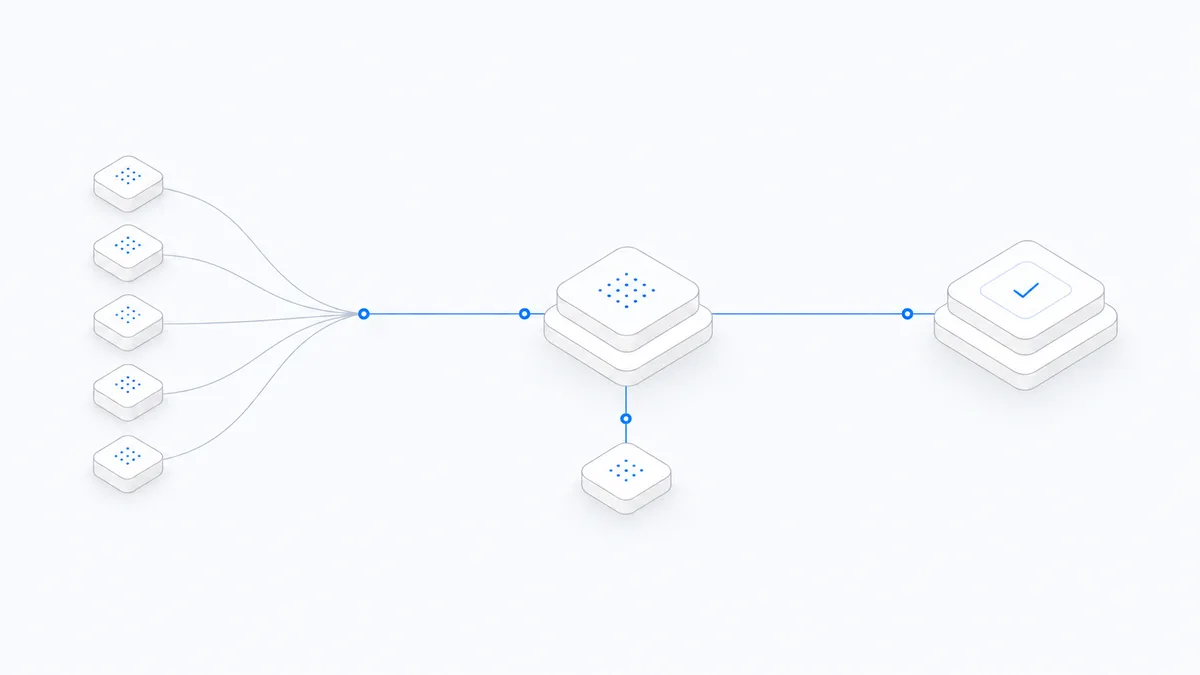
If your Codex quota drains faster than expected, do not begin with a magic prompt or an unverified configuration tweak. First measure how much capacity it takes to produce one result you actually accept. Then reduce the work that does not contribute to that result: repeated discovery, oversized context, unnecessary tools, duplicate retries, and full-task restarts.
The goal is not to bypass an OpenAI limit. It is to make each available window fund more useful, reviewable work while preserving the files, checks, and decisions you already paid to produce.
Last verified: September 16, 2026. Codex allowances, model rates, context handling, and product controls can change. Use the live Usage page and
/statusfor the active account. The practices below reduce avoidable work; they do not promise a fixed saving or change OpenAI's meter.Evidence boundary: OpenAI documents how conversation history, tool calls, repository instructions, and context management enter the Codex loop. Community reports help identify practical failure patterns, but their savings claims are not treated as universal benchmarks.
Start with the cost of one accepted result
Prompt count is a weak measure. One short request can launch many tool calls, while a longer, well-scoped request can finish with fewer corrections. Track a small set of representative tasks instead:
- Record the starting five-hour and weekly percentages.
- Define one outcome and its acceptance checks.
- Note the model, reasoning setting, tools, and starting project state.
- Run the task and review the result.
- Record the ending percentages, retries, and whether the result was accepted.
Compare quota used per accepted result, not quota used per message. A run that appears cheap but needs three repairs may cost more than a deliberate run that passes once.
The Codex quota-consumption breakdown explains how allowance, model rates, cached and uncached input, tool calls, and rework can produce the same visible symptom. Use that diagnosis before changing several variables at once.
Give Codex one bounded outcome
An open-ended instruction such as “improve this repository” forces the Agent to decide what to inspect, what to change, and when it is done. That discovery work can expand into more files, tools, and retries than the actual fix.
A quota-aware task brief should name:
- the outcome;
- the files or component likely involved;
- protected areas that must not change;
- the acceptance checks;
- the action that requires approval; and
- the stopping condition.
For example:
This is not about making every request tiny. It is about giving one Session a coherent job. If a task has independent research, implementation, migration, and review phases, preserve a checkpoint between them instead of asking one growing conversation to rediscover everything.
Keep context useful, not merely large
OpenAI's explanation of the Codex agent loop says that later turns include conversation messages and tool calls from earlier turns. As a thread grows, the prompt grows too. More context can preserve important decisions, but it can also carry obsolete plans, long logs, repeated instructions, and failed approaches.
Use context as a curated working set:
- keep the current goal, constraints, accepted decisions, and relevant files;
- summarize long investigation output into confirmed findings and open questions;
- store durable project facts in repository files rather than repeating them in every prompt;
- remove copied logs once the useful error and reproduction steps are captured;
- start a fresh Session at a real phase boundary, not after every message.
OpenAI's harness-engineering guidance describes a short AGENTS.md as a map to deeper sources of truth rather than a large manual injected into every task. The practical lesson is to keep universal instructions short and route specialized guidance through relevant files or Skills. The Astra instructions guide provides a focused audit for repeated reading, conflicting rules, and unnecessary pauses.
Do not delete necessary constraints simply to reduce tokens. A missing deployment rule or data boundary can create a costly mistake and a full redo. Remove redundancy, not authority.
Control tools, subagents, and retries
Tools are useful because they let Codex inspect and verify reality. They also create output that can enter the working context. Keep the tools that serve the current task and disable or ignore integrations that do not.
Before a long run, check:
- Does this task need web access, every MCP server, and multiple subagents?
- Can one targeted search replace a repository-wide scan?
- Can a test run against the affected package instead of the entire monorepo?
- Is a second Agent solving an independent subproblem, or duplicating the main Agent's reading?
- Does the next retry address a new hypothesis, or merely repeat the same request?
When a run fails, inspect partial output before restarting. Keep valid file changes, captured evidence, and passing checks. Retry only the missing step. Repeating the original prompt from an unchanged state can reproduce the same failure while consuming another window.
This rule also prevents accidental side effects. If a tool may already have sent a message, changed infrastructure, or charged an account, verify the external state before asking Codex to repeat it.
Save a checkpoint before changing Sessions or Agents
A useful checkpoint is compact, inspectable, and independent of private reasoning. Save:
- the current files and diff;
- what has been verified;
- commands already run and their relevant results;
- approved decisions and protected boundaries;
- open risks; and
- the next bounded action.
If Codex reaches a limit, becomes unreliable, or no longer fits the next phase, another Session or Agent can continue from that state. The Agent handoff guide provides a reusable handoff format.
Agent.Space can keep project files and separate Sessions in one Workspace. For a Codex-to-Claude Code review boundary, the shared-project workflow shows what should carry across and what remains separate. This does not transfer private reasoning or refill an OpenAI allowance. It reduces the need to reconstruct a project from an empty environment.
Know what these practices cannot change
Workflow improvements cannot determine or alter:
- the allowance attached to an OpenAI plan;
- model-specific rates or temporary promotions;
- shared activity elsewhere in the same account or workspace;
- a service incident or incorrect meter;
- the availability of a banked reset, paid reset, Credits, or API route.
If Codex already says the limit is reached, use the usage-limit recovery guide to identify the actual meter and the official options displayed for that account. Do not treat context cleanup as a reset mechanism.
Likewise, lower consumption is not automatically better. A cheaper run that skips validation, misses a constraint, or produces code that must be rewritten has not saved useful capacity. Optimize for accepted outcomes and reversible steps.
A repeatable quota-saving checklist
Before the task:
- Choose one outcome and one definition of done.
- Name likely files, protected areas, and required checks.
- Keep only relevant instructions, tools, and source material.
- Record the starting usage window for representative measurements.
During the task:
- Stop broad exploration once the cause is supported by evidence.
- Summarize long logs and preserve only the useful finding.
- Review partial work before retrying.
- Add a checkpoint at each real phase boundary.
After the task:
- Grade whether the result was accepted.
- Record retries and ending usage.
- Fix recurring repository ambiguity at its source.
- Compare several similar tasks before changing plans or models.
If you need a persistent place for those files, checks, and handoffs, review how Agent.Space Workspaces operate and current plans. Agent.Space is an independent product, not an OpenAI quota extension. If the available Agent, model, and billing path fit your work, start a Workspace and carry forward the project state instead of restarting from scratch.