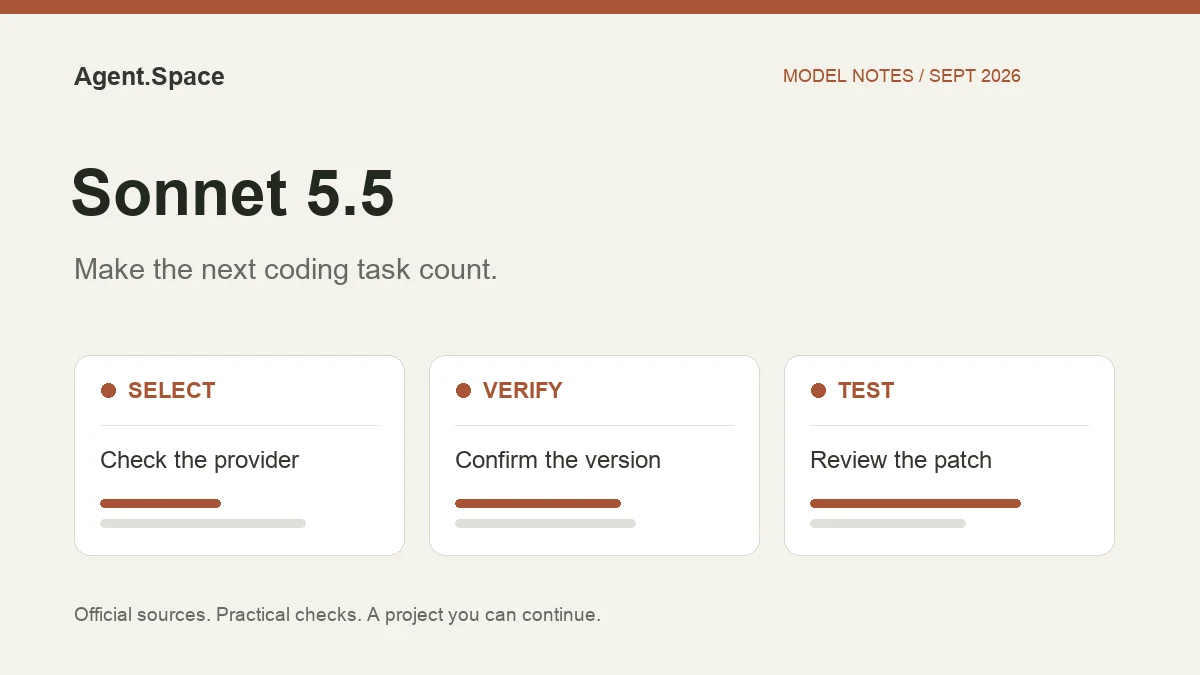
Claude Sonnet 5.5 launched on September 28. Anthropic reports faster output and lower task costs than Sonnet 5, while positioning Opus 5.5 for more complex, open-ended work. That makes Sonnet worth testing on everyday coding—but a release announcement cannot tell you which model your Claude Code session actually uses. Official announcement.
Verified September 29, 2026. This guide checks official configuration documentation. It does not report Agent.Space benchmark results or promise a fixed speed or cost improvement.
Start by checking what sonnet means on your provider
Claude Code accepts aliases and provider-specific model names. Its model configuration documentation currently maps sonnet to Sonnet 5.5 on the Anthropic API, Sonnet 4.6 on Claude Platform on AWS, and Sonnet 4.5 on Amazon Bedrock, Google Cloud's Agent Platform, and Microsoft Foundry.
The same command can therefore request different versions on different providers. A custom gateway or organization model policy can introduce additional configuration. Changing the endpoint alone does not select Sonnet 5.5.
On the direct Anthropic route, select Sonnet in a supported session:
Then check /status and the model shown in the session. For a provider-specific deployment, choose an ID that exists on that provider rather than substituting an Anthropic ID into an ARN or deployment-name field.
Keep a brief record of the client version, provider, requested model, effective configuration, and billing route. It is far more useful for reproducing a result than a screenshot labeled only “Claude Code.”
If Sonnet 5.5 does not appear
Work through the actual access conditions:
- Confirm the active account and provider route.
- Check whether that route exposes the new version.
- Review project, user, and organization settings that select or restrict models.
- Verify that the client supports the current catalog and configuration.
- Read the exact failure message before changing credentials or plans.
Do not remove an organization's model restriction to make a personal experiment work. Ask the administrator to evaluate the requested model. If the route does not provide Sonnet 5.5, use an available model for the task or deliberately choose another approved route.
The model-routing verification guide helps separate requested identity from response metadata. That distinction matters if a task notice reports a model change or a child task uses another configuration.
What does Sonnet 5.5 cost?
Anthropic lists Standard API rates of $2 input, $10 output, and $0.20 cache reads per million tokens for Sonnet 5.5. Current API pricing. These are usage rates, not a monthly Claude Code plan price.
Whether those rates affect your bill depends on authentication and the payment path. Included subscription usage, eligible Usage Credits, and a separately billed API key are different arrangements. Before a sustained task, use the Claude Code pricing guide to identify which one is active.
For the full cache-write table and a worked cost comparison, see Opus 5.5 vs Sonnet 5.5. Keeping the calculation in one place makes it easier to maintain when rates change.
API integrations need an additional upgrade check
Changing a Claude Code selection and migrating your own Messages API application are different tasks. The Sonnet 5.5 migration guide documents breaking changes: thinking.type: "disabled" is rejected, as are forced any/tool choices. The lowest thinking mode is now between_tools, with effort constraints. Read response blocks by type and preserve thinking blocks in tool loops.
If your application currently reads only content[0].text, include a response with thinking and a complete tool round trip in the upgrade test. A successful HTTP status alone does not establish that the application can display and continue the result.
Test the upgrade on a bug you can reproduce
Here is a task brief you can adapt. It is an editorial example, not an Anthropic benchmark prompt:
Give Sonnet 5.5 and your previous model independent copies of the same starting state. Compare the patches before reading their explanations. Did each fix the defect? Did it change unrelated behavior? How much repair or review did the result need?
Record whole-task usage and elapsed time. Faster output does not necessarily mean a faster accepted result, and a reduced task-cost claim does not guarantee the same percentage for your repository. The coding-agent regression evaluation guide provides a repeatable evaluation method.
When to evaluate Opus as well
Consider a separate Opus trial when the brief remains ambiguous, evidence spans several subsystems, or the cost of a plausible mistake is high. This is a selection hypothesis to validate, not a promise that Opus wins every hard task. Do not compensate for a weak brief by giving either model unrestricted authority.
For a harness-level decision instead of a model upgrade, use the Codex vs Claude Code comparison.
Continue the project in Agent.Space
Agent.Space can keep supported Agent Sessions, saved files, and explicit review artifacts with a cloud project. Check the live model selector and current pricing before assuming Sonnet 5.5 is enabled for your harness and account.
If that combination fits your work, start an Agent.Space Workspace with the reproduced bug and acceptance checks. Save the resulting patch and evidence so another Session or teammate can review it. The Claude Code on Agent.Space guide explains the product boundary and setup.